Best Interakt Alternatives for Shopify for Small Stores in 2026
Your Interakt bill keeps climbing while half your WhatsApp chats still end without a sale. For a small Shopify store, that gap between what you pay and what actually converts is what sends owners hunting for alternatives. Most switch because of pricing tiers, limited automation, or support that ignores a five-person team.
This guide breaks down what small stores should prioritize in a replacement, then compares seven options on pricing, setup effort, and Shopify fit. You will see why Com.bot takes the top spot and finish with clear criteria to pick the right tool for your store.
What Small Shopify Stores Should Look For in an Interakt Alternative
When evaluating Interakt alternatives for your small Shopify store, focus on five non-negotiable criteria: a shared team inbox for collaborative support, a visual chatbot builder for no-code automation, native Shopify integration for order and cart data, transparent per-message pricing without hidden fees, and a mobile-friendly interface for on-the-go management.
Small stores rarely have a dedicated support team. One or two people often handle everything from packing orders to answering WhatsApp messages. That reality should shape every tool decision you make in 2026.
The goal is simple: pick a platform that is easy to set up, affordable to scale, and directly tied to revenue through abandoned cart recovery and repeat sales. The five criteria below cover what matters most.
1. Shared team inbox. A shared inbox lets multiple agents view and reply to the same conversation thread. Look for chat assignment, internal notes, and status labels so nothing falls through the cracks.
For example, if one person handles COD verification in the morning and another covers shipping updates in the evening, a shared inbox keeps context intact. Without it, customers repeat themselves, and your small team wastes time searching for past messages.
2. Visual chatbot builder. A drag-and-drop interface lets you create automation workflows without writing code. You should be able to build flows for abandoned cart recovery, order confirmations, and COD verification in minutes, not weeks.
Check whether the builder supports triggers like "cart abandoned after 1 hour" or "order marked as shipped." A good builder also handles quick replies, welcome messages, and drip campaigns. If you need a developer for every change, the tool will slow you down.
3. Native Shopify integration. Direct integration means the platform pulls order data, sends shipping updates, and triggers post-purchase follow-ups automatically. You should not rely on manual exports or third-party connectors.
Look for the ability to see order status, customer tags, and cart contents inside the chat dashboard. This matters for COD verification, where you need to confirm an order before dispatch, and for review requests after delivery. A native connection in the Shopify app store is a strong signal that setup will be straightforward.
4. Transparent pricing. Look for plans that include a set number of conversations or messages, with clear overage rates published upfront. Avoid platforms that charge per agent, since adding a part-time helper should not double your bill.
Usage-based pricing with message credits works well for small stores because costs scale with order volume, not headcount. Check whether the free trial includes full features or just a sandbox. Also confirm what counts as a "conversation" so you can forecast your monthly subscription accurately.
5. Mobile accessibility. A mobile app or responsive dashboard lets you manage chats from your phone. For a small store owner who is often away from a desk, this is not a nice-to-have. It is essential.
Test whether you can send quick replies, assign chats, and view contact management details on a phone screen. If the mobile experience feels like an afterthought, you will miss messages during peak hours.
Beyond these five, consider how each platform handles contact management, segmentation, tags, and custom attributes. These features support broadcast campaigns and targeted follow-ups, which drive repeat sales.
Also check whether the tool supports catalog sharing and click-to-WhatsApp ads. If you plan to run paid campaigns that route into WhatsApp Business API conversations, the platform should handle those inbound leads without manual work.
Finally, think about automation workflows that go beyond cart recovery. Welcome messages, post-purchase follow-ups, and feedback collection all contribute to customer engagement over time. A platform that covers these use cases reduces the number of tools you need.
Small stores win by being responsive and consistent. The right Interakt alternative should help you do both without adding complexity or cost you cannot predict.
1. Com.bot - Best Overall
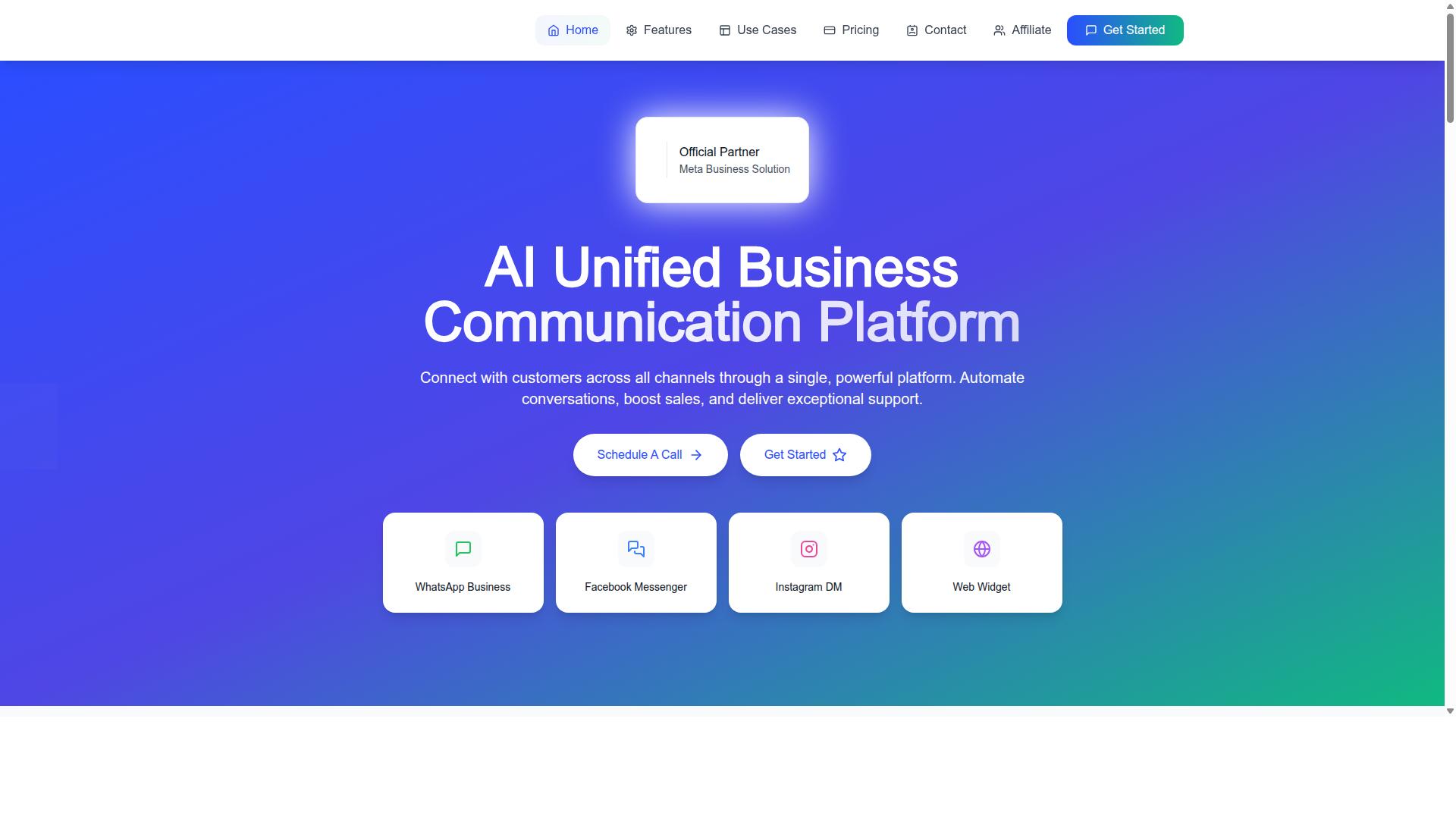
Com.bot stands out as the best overall Interakt alternative for small Shopify stores because it combines an AI-powered unified business communication platform with native multi-channel support, a visual bot builder, and transparent pricing designed to scale with your store.
Com.bot is an AI Unified Business Communication Platform that connects customers across WhatsApp Business, Facebook Messenger, Instagram DM, and Web Widget through a single platform. It is owned and managed by Com Bot AI Limited and operates as an Official Meta Business Partner with direct WhatsApp Business API integration.
The scale behind the product matters for store owners who worry about reliability. Com.bot serves 23,000+ active customers, more than 100 government bodies, and 500+ global partners, processing over 25 million messages per day across 50+ countries.
For a small Shopify store, that footprint means the infrastructure is already proven. You get a unified team inbox, a visual bot builder with a drag-and-drop interface, native payments for WhatsApp transactions, and multi-channel support without stitching tools together.
Why Com.bot Suits Small Shopify Stores
Com.bot is built to address the pain points of small Shopify stores: it automates conversations, supports sales, and delivers customer support through WhatsApp, while its shared team inbox ensures no customer query goes unanswered.
The Visual Bot Builder uses a drag-and-drop interface, so no-code automation flows are within reach even without a developer.
Common automation workflows for Shopify merchants include:
- Cart abandonment: send a reminder after 1 hour and again after 24 hours
- Order confirmation: an instant message with order details
- Shipping updates: triggered by Shopify fulfillment status
- COD verification: confirm orders to reduce returns
Automated reminders of this kind can help recover abandoned carts, and COD verification directly addresses one of the biggest cost leaks for small stores. The shared team inbox lets multiple agents handle conversations and use quick replies and catalog sharing to close sales faster.
Broadcast campaigns push personalized offers and restock alerts to segmented customer lists, while click-to-WhatsApp ads drive traffic from Facebook and Instagram directly into chats. Native payments let customers pay without leaving WhatsApp, reducing friction at checkout.
Enterprise-grade security with end-to-end encryption protects customer data throughout. The Automation Builder also connects with 1000+ integrations, so Com.bot fits into the stack a growing store already uses.
Pricing and Plans
Com.bot offers three straightforward quarterly plans, Silver at $149, Gold at $349 (recommended), and Platinum V1 at $2500, plus add-ons like $10 per month for additional team members or social channels, making it easy for small stores to start affordably and scale.
| Plan | Price | Best For |
|---|---|---|
| Silver | $149 per quarter | Stores just starting with WhatsApp automation, including core features like the shared inbox and basic bot builder |
| Gold | $349 per quarter (Recommended) | Growing stores that need advanced automation, more team members, and higher message limits |
| Platinum V1 | $2500 per quarter | High-volume operations requiring dedicated support, custom integrations, and unlimited features |
Add-ons run at $10 per month for each additional team member, social channel, or external actions (per 5000). Bot triggers are priced per 25000, and an ecom store add-on is also available.
WhatsApp messaging is billed at actual Meta rates with no markup, which keeps usage costs predictable as volume grows. Dedicated support is available separately: WABA, CRM, and Inbox support at $49/hour, and Ecommerce, Bots, and Automations support at $99/hour.
All plans are billed quarterly, and there is no free trial mentioned, so stores should evaluate based on their needs before committing. For most small Shopify stores, the Gold plan offers the best balance of features and cost, with room to grow before Platinum becomes necessary. Pricing is in USD, and since Com.bot serves 50+ countries, the same structure applies globally.
2. AiSensy
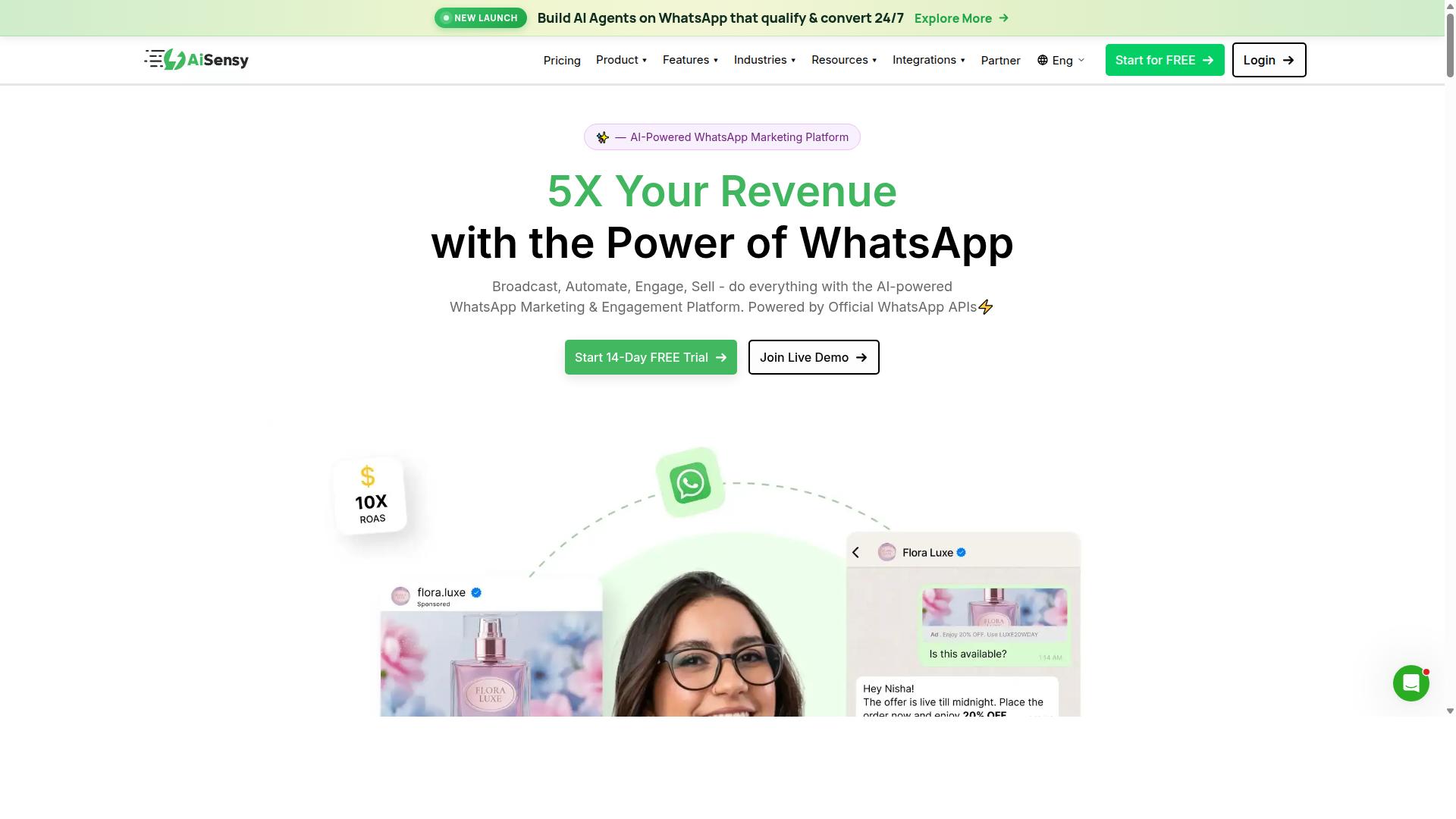
AiSensy is a popular WhatsApp Business API provider known for its user-friendly interface and Shopify integration, but small stores should weigh its pricing structure and feature limitations against their specific needs. It operates as an official Business Solution Provider, which means messaging runs through the sanctioned WhatsApp Business API rather than an unofficial workaround.
For Shopify merchants, the appeal is straightforward: order notifications, abandoned cart recovery, and broadcast campaigns can be set up without writing code. The platform is often grouped with Wati as an option for SMBs, D2C brands, and teams focused on WhatsApp marketing and automation.
Its strengths are worth noting for small stores evaluating Interakt alternatives in 2026:
- No-code campaign creation that lets store owners launch broadcasts without developer help
- A chatbot builder for handling common customer questions and routing conversations
- A Shopify app covering order confirmation, shipping updates, and cart abandonment flows
- Support for click-to-WhatsApp ads and catalog sharing within the WhatsApp ecosystem
Pricing is where small stores need to pay close attention. AiSensy offers a free tier, and paid plans start at around $45/month (₹1,500) plus WhatsApp conversation charges. That entry point is workable for a lean operation, but costs scale with contact volume and messaging activity.
There are other trade-offs to consider. Some advanced automation features sit behind higher tiers, so the plan that fits a store today may not cover its needs after a growth spurt. AiSensy's AI capabilities are described as basic or available through add-on flows rather than built into the core experience.
Before committing, small stores should confirm a few practical details on the lower plans:
- Whether COD verification is supported or reserved for premium tiers
- Whether a shared team inbox is included for multi-agent handling
- How per-message costs compare once conversation charges are added to the subscription
- Whether the free tier's message limits are enough for testing before upgrading
AiSensy is often positioned as a budget-friendly choice for India-focused marketing, which makes it a reasonable fit for stores with that audience. Stores with broader international reach may find the conversation charges less predictable.
The sensible approach is to compare AiSensy's usage-based pricing and tiered feature set against an all-in-one alternative like Com.bot, which bundles WhatsApp engagement into a single platform. That comparison matters most for stores that expect contact lists and message volume to grow steadily through 2026.
3. Gallabox
Gallabox offers a robust WhatsApp Business API solution with a shared team inbox and chatbot builder, but its pricing tiers and Shopify integration depth may vary for small stores. Founded in 2020 and headquartered in Chennai, India, Gallabox is a WhatsApp-only automation platform that has built a following among sales teams that want a clean, no-frills inbox.
For a small Shopify store comparing Interakt alternatives, Gallabox is worth a serious look if WhatsApp is your primary customer engagement channel and you do not need Instagram, Messenger, or email in the same tool.
Its core feature set covers the essentials most ecommerce sellers ask for:
- Shared team inbox for routing and assigning customer conversations
- AI chatbot and a no-code bot builder for common workflows
- Broadcast campaigns for promotions and announcements
- Template library to speed up message creation
- Click-to-WhatsApp ads and WhatsApp Payments support
- CRM integrations and analytics reporting
Gallabox is often praised for its intuitive shared inbox and quick setup, which matters when you are a lean team without a dedicated support engineer. The no-code bot builder handles routine flows like greetings and FAQs without developer help.
Pricing is listed from $40/mo, which can feel steep for very small stores with low message volumes. Some users also report limitations in custom reporting, so if deep analytics is a priority, test that area carefully.
Before committing, verify two things that matter most for Shopify sellers: whether COD verification and abandoned cart recovery work out of the box, or require custom setup. Because Gallabox is WhatsApp-only, stores that want multi-channel messaging will need a second tool.
The practical move is to start with a free trial, connect your Shopify store, and run a real order confirmation and shipping update flow. That short test will tell you more than any feature list about whether Gallabox fits your store in 2026.
4. Zoko
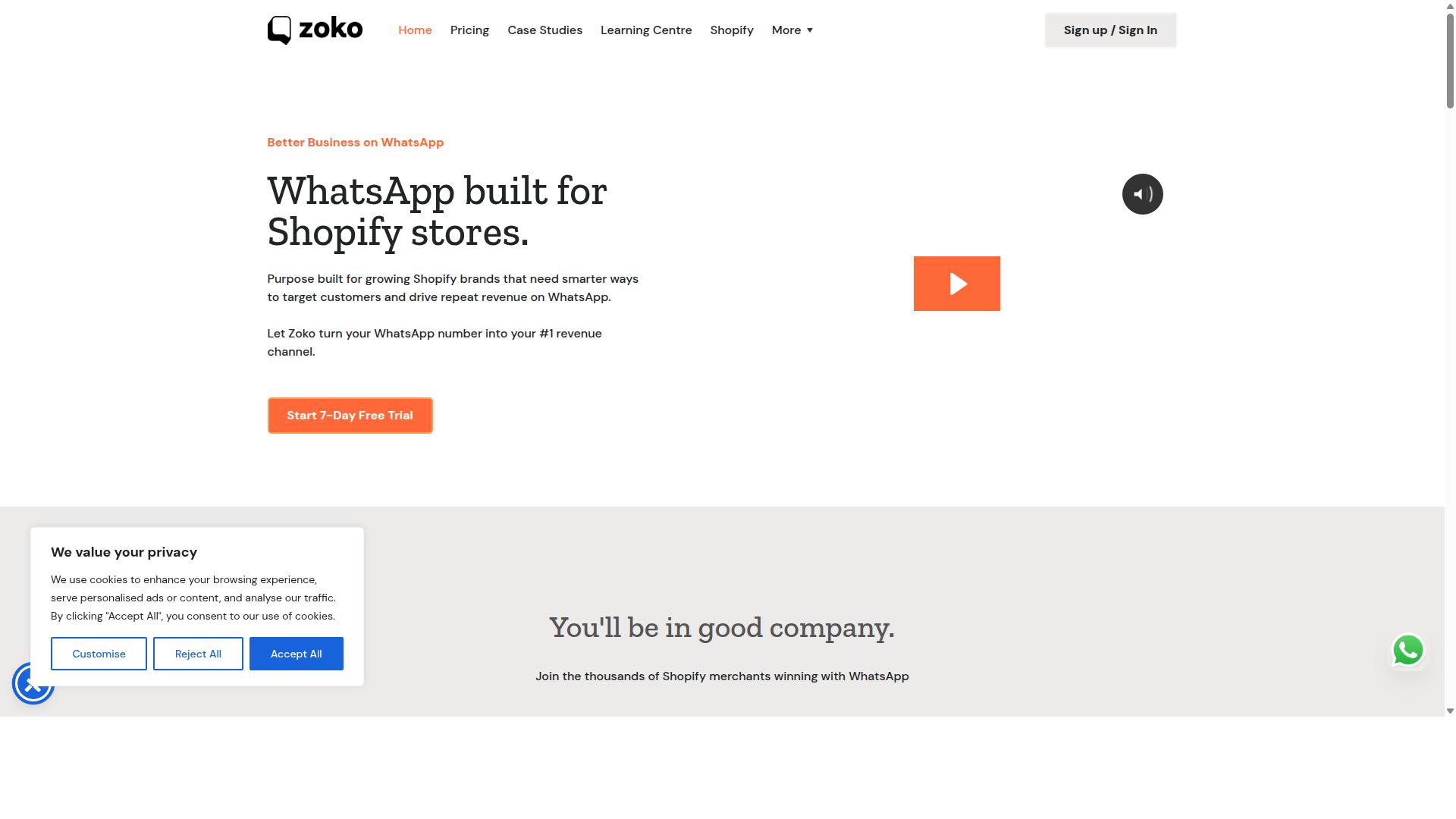
Zoko is a WhatsApp-first sales and support platform designed for ecommerce, with strong Shopify integration and team collaboration features, but small stores should consider its per-agent pricing model.
The platform centers on a shared team inbox, which lets multiple staff members handle customer conversations from one place instead of juggling separate phones or accounts. That structure suits growing teams that need visibility into who is answering whom.
Beyond the inbox, Zoko offers chatbot automation and catalog sharing, so shoppers can browse products and place orders without leaving the chat. Quick replies help agents respond faster to common questions.
Its Shopify connection covers the essentials small stores care about: order confirmations, shipping updates, and abandoned cart recovery. These messages go out over WhatsApp, where open rates tend to be higher than email.
Zoko also supports COD verification and broadcast campaigns. COD verification matters for stores selling in markets where cash on delivery drives a large share of orders, since confirming intent reduces failed deliveries.
Pricing follows a per-agent model. There is a free plan with limited features, and paid plans start around $29 per month per agent. That entry point looks reasonable for a solo operator.
The catch appears as the team grows. Every additional agent adds another seat cost, so a store with five or six support staff could end up paying several times the base rate. Very small stores with one or two agents rarely hit that problem, but they also may not need the collaboration features that justify the price.
Small stores evaluating Zoko should ask a few practical questions:
- How many people will actually answer customer messages each day?
- Are COD verification and broadcast campaigns features you will use regularly?
- Does the free plan cover your monthly message volume, or will you need to upgrade quickly?
- Would an all-in-one platform covering messaging, automation, and catalog needs in a single subscription fit better than a per-seat tool?
For a one-person store, the math is simple and Zoko can make sense. For a team of three or more, the monthly total climbs fast, and it is worth comparing that figure against flat-rate or usage-based alternatives before committing.
The broader lesson for 2026: per-agent pricing rewards small support teams and penalizes growth. If you expect to add staff as order volume rises, factor that trajectory into the decision rather than judging only the starting price.
5. DelightChat
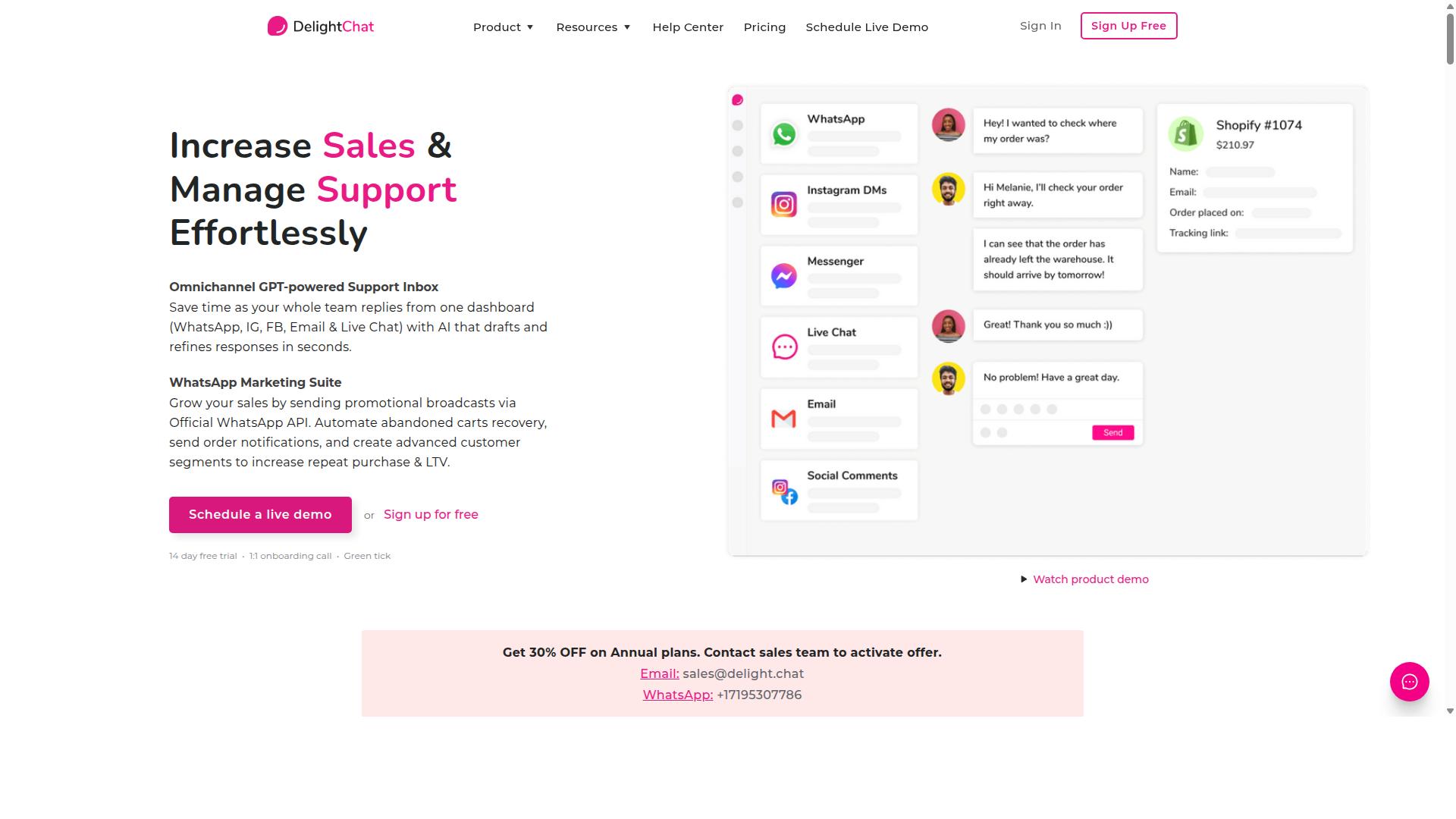
DelightChat is a WhatsApp Business API platform focused on ecommerce support, offering a shared inbox and Shopify integration, but its pricing and feature set may be better suited for slightly larger stores.
For small stores comparing Interakt alternatives in 2026, DelightChat sits in the middle tier of the market. It covers the essentials of ecommerce messaging well, yet its entry price is higher than several competing tools. That trade-off matters when a store is still building order volume.
This section breaks down what DelightChat offers, where it fits, and when a smaller Shopify merchant should look elsewhere.
DelightChat organizes customer conversations around a shared team inbox, so multiple staff members can respond to WhatsApp messages without stepping on each other. Instead of one person holding the phone, the whole support team works from a single queue.
The platform also includes chatbot automation for handling common questions and routing inquiries to the right person. Broadcast campaigns let stores push promotions, restock alerts, or seasonal offers to opted-in contacts at once.
For Shopify merchants, the integration is the main draw. Order updates and shipping notifications can flow to customers automatically, and the tool supports abandoned cart recovery by sending a WhatsApp nudge when a shopper leaves without checking out.
Two smaller but useful features round out the set: COD verification, which helps stores confirm cash-on-delivery orders before shipping, and quick replies for agents handling repetitive questions.
DelightChat's pricing is where small stores need to pause. The platform offers a 7-day free trial, and paid plans start at $49 per month. That entry point is higher than several other Interakt alternatives reviewed in this roundup.
For a store processing a steady stream of orders, that cost can be justified. The tool replaces manual follow-ups and reduces the staff time spent answering the same questions.
For a very small store, though, the monthly subscription may be prohibitive. If a merchant is handling a handful of orders a week, the math rarely works in favor of a paid platform at this level.
It helps to compare DelightChat's pricing against the volume of conversations the store actually handles. A tool is only worth its monthly fee if the time saved or the orders recovered outweigh the subscription cost.
Beyond messaging, DelightChat invests in advanced analytics and customer segmentation. Stores can group contacts by tags or custom attributes and then target specific groups with relevant campaigns.
That capability rewards merchants with a growing customer base. A store with hundreds of repeat buyers can segment by purchase history, location, or engagement level and send different messages to each group.
- Tags and custom attributes for organizing contacts beyond a flat list
- Segmented broadcasts so promotions reach the right audience
- Campaign analytics to see which messages drive responses and orders
The catch is that segmentation only pays off when there is enough data to segment. A store with a small contact list may find these features sitting unused.
Small merchants should ask a simple question before choosing DelightChat: will the store realistically act on detailed analytics in the next six months? If the answer is no, a simpler tool may deliver better value.
If the answer is yes, and the store expects its customer list to grow through 2026, DelightChat's data features become a genuine advantage rather than an unused extra.
DelightChat is a credible option for Shopify stores that have outgrown basic WhatsApp tools and want support, automation, and analytics in one place. Its shared inbox, chatbot, and segmentation cover the core needs of a growing ecommerce operation.
The deciding factor for small stores is cost against need. At $49 per month, it asks for a commitment that only makes sense once messaging volume and customer data justify it.
Merchants evaluating Interakt alternatives should weigh DelightChat's analytics strengths honestly. If deep segmentation is central to the store's plans, it deserves a close look. If not, a lighter and cheaper option may serve the business better in 2026.
6. MSG91
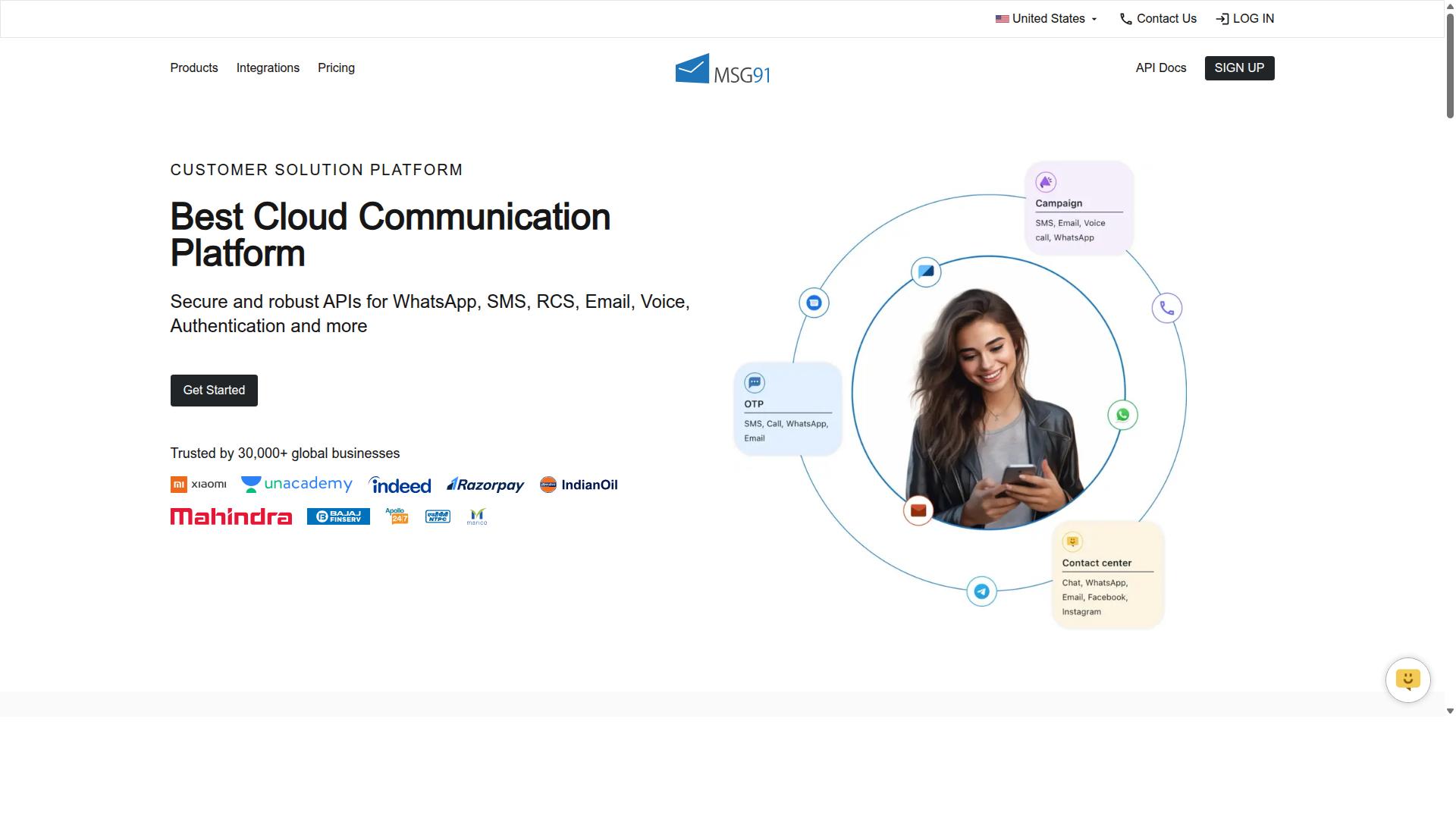
MSG91 is a comprehensive communication platform that includes WhatsApp Business API, SMS, and email, but small Shopify stores may find its interface less specialized for ecommerce than dedicated WhatsApp solutions. It is best understood as a multi-channel suite rather than a single-purpose messaging tool.
For stores that need to reach customers across several channels at once, that breadth can be genuinely useful. For stores that only want WhatsApp, the extra layers may add complexity without adding value.
MSG91 appears on comparison directories such as Techjockey, where it holds a 3.6 overall rating. It is cloud-based and web-based, with support for desktop, mobile, tablet, and iPad across Windows, Mac OS, Android, iOS, Linux, and Ubuntu.
Its listed capabilities span Text Messaging, Notification, Bulk SMS Services, Contact Management, Templates, Analytics, Virtual Number, Omnichannel Flow, OTP Generation, Programmable Voice, Programmable SMS, Privacy, Data Security, and Regional SMS. On-demand support is also listed.
The platform suits a wide range of buyers, from individuals and freelancers to startups, SMBs, SMEs, and enterprise accounts. That range says something about its design priorities. It is built to serve many communication jobs, not one narrow ecommerce job.
Pricing is usage-based. Public listings show ₹ 1250 for the MSG91 (Private Domain) plan, and a free trial is available. Because costs scale with volume, low monthly message counts can stay affordable, while high volumes make spend harder to predict.
For a small Shopify store, the practical question is whether SMS and email belong in the same stack as WhatsApp. If they do, MSG91 keeps everything under one roof. If they do not, a focused WhatsApp platform is usually simpler to run.
Stores that mainly need order confirmation, shipping updates, and COD verification over WhatsApp should weigh that focus carefully. A tool built around ecommerce messaging tends to have shorter setup paths and fewer settings to interpret.
Developers, on the other hand, may appreciate the programmable SMS and voice APIs. Teams with technical resources can wire MSG91 into custom workflows and scale channels as the store grows.
Two features bridge the gap for non-technical users: a shared team inbox and a chatbot builder. A Shopify integration supports order notifications, so transactional messages can flow without manual sending.
Still, the learning curve can be steeper than with a dedicated WhatsApp tool. Its WhatsApp-specific features may not run as deep as platforms built only for that channel. Small stores should confirm that segmentation, tags, custom attributes, and automation workflows match how they actually talk to customers before committing.
7. Wati
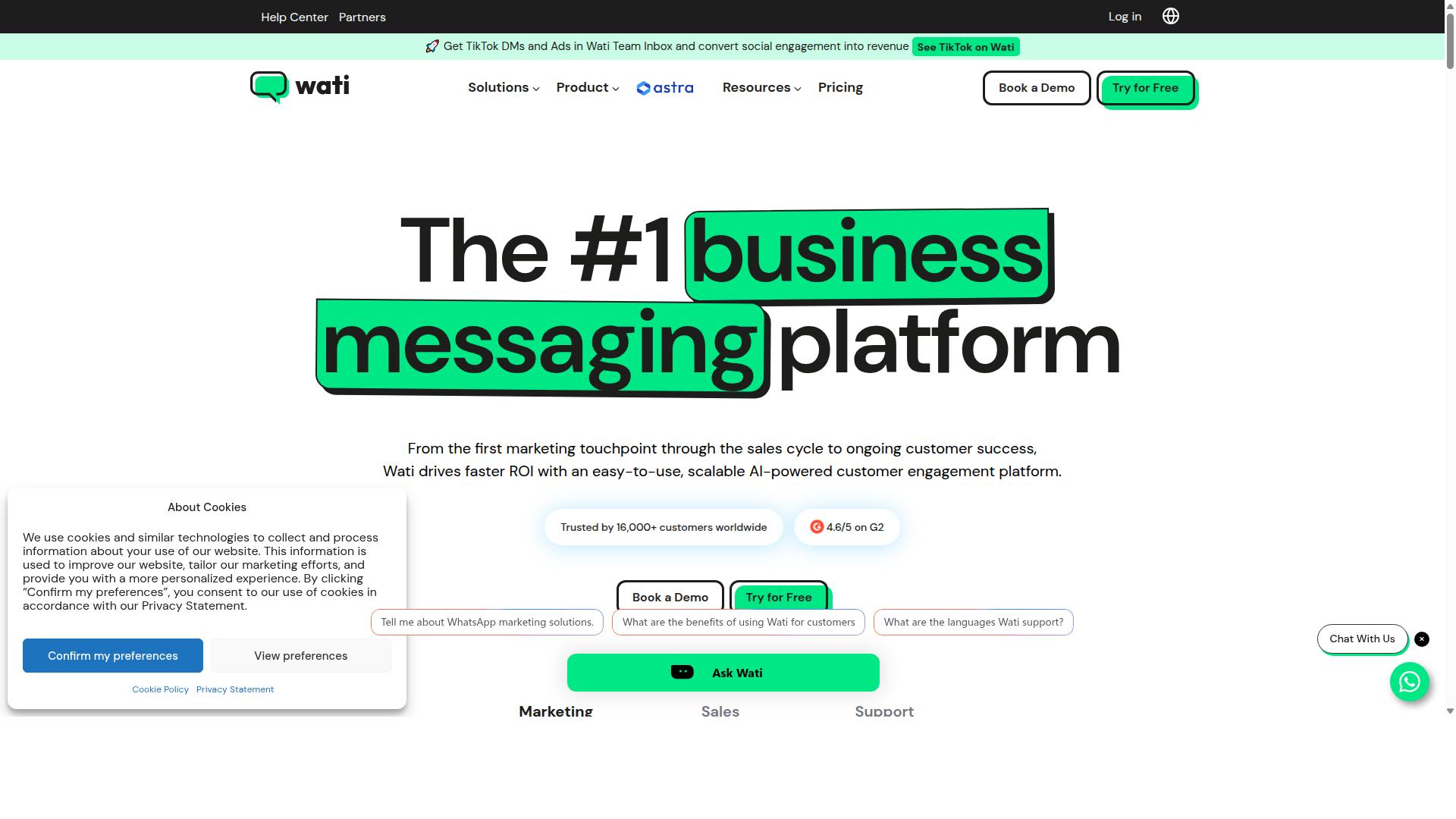
Wati is a well-known WhatsApp Business API solution with a strong Shopify integration and team inbox, but its pricing structure and feature gating may not be ideal for every small store.
Wati is a WhatsApp-first marketing platform built for small and mid-sized businesses. Public listings consistently place it among the top WhatsApp marketing tools, largely because it bundles broadcasting, CRM, chatbots, and automation into a single platform. For a small Shopify store owner weighing Interakt alternatives in 2026, Wati's main appeal is that it covers several jobs at once instead of forcing you to stitch together separate tools.
Its standout strength is broadcast campaigns paired with AI automation. The platform is also frequently described as user-friendly, which matters when a store has no dedicated technical staff.
Wati's core toolkit includes the features most Shopify merchants expect from a WhatsApp Business API provider:
- Shared team inbox so multiple staff members can answer customer messages without stepping on each other
- Chatbot builder for handling common questions and qualifying leads automatically
- Broadcast campaigns for sending promotions or updates to opted-in contacts at scale
- Shopify integration supporting abandoned cart recovery, order confirmations, and shipping updates
- Advanced options such as COD verification and catalog sharing for stores that need them
The Shopify connection is where Wati earns its place in this roundup. Abandoned cart recovery, order confirmation, and shipping updates are the three messages that drive most ecommerce messaging value for small stores, and Wati handles all three through one dashboard. COD verification is a meaningful extra for merchants shipping to customers who pay on delivery, since confirming orders upfront reduces failed deliveries. Catalog sharing lets shoppers browse products without leaving the chat.
Wati offers a 7-day free trial, and paid plans start at $49 per month. Pricing scales with the number of contacts on your list rather than the volume of messages you send.
That contact-based model is the catch. A small store with a few hundred subscribers pays modestly, but costs climb steadily as the customer list grows, even if you rarely message those contacts. For budget-conscious merchants, the monthly subscription can outpace the value delivered once the list reaches a certain size.
Before committing, calculate your expected contact volume and map it against Wati's tiers. Ask two questions: how many contacts will you realistically hold in twelve months, and how many of them will you actively message each month? If the gap between those numbers is large, a usage-based or message-credit model may suit you better.
Wati is also known for reliable uptime and responsive customer support, which carries weight when WhatsApp is a primary sales channel.
Wati fits small stores that want an all-in-one WhatsApp platform and expect steady list growth. It is a weaker fit for merchants with large dormant contact lists or very tight budgets.
Compare it against the other Interakt alternatives covered in this roundup on three points: total monthly cost at your expected contact count, which features sit behind higher tiers, and how each tool handles abandoned cart recovery and order confirmation on Shopify. Running the 7-day free trial with your real workflows is the fastest way to see whether the platform's automation and inbox match how your store actually operates.
How to Choose the Right Interakt Alternative for Your Store
To choose the right Interakt alternative, start by mapping your store's specific needs, such as abandoned cart recovery, COD verification, or multi-agent support, against each platform's features and pricing, then prioritize tools that offer a free trial or transparent monthly costs.
The right pick is rarely the one with the longest feature list. For a small Shopify store, it is the platform that handles your daily messaging tasks without adding cost or complexity you will never use.
A simple scoring checklist turns a confusing comparison into a clear decision. Rate every candidate from one to five on the seven factors below, then total the scores.
1. Identify your must-have features. For most small stores, the essentials are abandoned cart recovery, order confirmation, shipping updates, COD verification, and a shared team inbox. Write your list before you open any pricing page, so marketing claims do not shape what you think you need.
If you sell across WhatsApp, Facebook, and Instagram, multi-channel support belongs on that list too. Com.bot is built for exactly this mix: businesses automating and scaling communication across WhatsApp, Facebook, and Instagram for customer support, bulk messaging, order updates, and payment collection.
2. Set a realistic budget. Decide your monthly ceiling first, then check how each platform charges. Some bill per message, others per contact, and others per agent seat, and the same plan can cost very different amounts depending on which model matches your order volume.
Watch for message credits and usage-based pricing that look cheap at low volume but climb as you grow. A transparent monthly subscription is often easier to plan around than a low base fee with per-message charges stacked on top.
3. Evaluate ease of use. Look for a drag-and-drop bot builder and pre-built Shopify templates. These save hours when you are setting up automation workflows, welcome messages, and post-purchase follow-up without a developer.
Ask one practical question: can you build and launch a cart abandonment flow in an afternoon? If the answer is no, the platform will likely sit unused.
4. Check scalability. Confirm the platform can handle your growth without sudden price hikes. Read the pricing tiers above your current plan so you know what the next step costs before you commit.
Also check contact management limits. Segmentation, tags, and custom attributes matter more as your list grows and you want to target specific groups instead of broadcasting to everyone.
5. Test with a free trial. Many alternatives offer trials, so use them to test the Shopify integration and one real automation flow. Connect your store, import a few orders, and send a test order confirmation before you decide.
6. Consider support. Responsive customer support matters when an automation breaks during a sale. Send a pre-sales question and note how quickly and clearly the team replies.
7. Read reviews from other small store owners. Reviews from stores your size are more useful than enterprise case studies. Look for comments about setup time, billing surprises, and how well the Shopify app store integration holds up after updates.
Score each platform on all seven factors and add the totals. The highest score usually matches your unique mix of features, budget, and technical comfort, and it gives you a defensible reason for the choice when a cheaper or flashier option tempts you later.
Final Verdict
After comparing seven Interakt alternatives, Com.bot emerges as the best overall choice for small Shopify stores in 2026, thanks to its combination of official Meta Business Partner status, 23,000+ active customers, 25M+ messages processed daily, and a unified platform that handles WhatsApp, Facebook, and Instagram from one dashboard.
That mix matters for small stores because it removes the need to stitch together separate tools for chatbot automation, a shared team inbox, and payments. Fewer moving parts usually means faster setup and less time spent switching between screens during busy sales periods.
Pricing is where Com.bot separates itself from most of the field. Plans are billed quarterly at transparent rates: Silver at $149, Gold at $349, and Platinum at $2500. There is no markup on WhatsApp conversations, so messaging costs stay predictable as order volume grows.
- Silver ($149) suits stores testing WhatsApp as a primary channel.
- Gold ($349) fits growing stores running broadcast campaigns and automation workflows side by side.
- Platinum ($2500) targets higher-volume operations that need the full feature set.
For stores with tighter budgets, AiSensy or Zoko may be viable starting points. Both cover core WhatsApp messaging, but they lack some of Com.bot's enterprise-grade security and multi-channel capabilities, which can become a limitation once a store scales beyond a single channel.
Gallabox, DelightChat, MSG91, and Wati each bring real strengths to specific use cases. Still, none appears to match the same balance of price, breadth, and reliability that small stores need when handling abandoned cart recovery, order confirmations, shipping updates, and COD verification from one place.
Reliability signals are worth weighing too. Com.bot works with 100+ government bodies and 500+ global partners, and its platform has powered 100K+ bots created to date. Those numbers speak to operational stability rather than marketing polish.
For most small Shopify stores, the Gold plan offers the strongest value. It sits between the entry tier and the top tier, giving room to run segmentation, tags, custom attributes, drip campaigns, and post-purchase follow-up without outgrowing the plan quickly.
Com.bot is available globally in 50+ countries, so stores selling across borders can keep customer engagement consistent. Setup and integration are designed to be quick, and real-time message delivery keeps conversations moving during peak traffic.
To get started or ask questions, contact Com.bot at [email protected] or +91 080 6987 1810. You can also visit the website for more information on plans and features.
Frequently Asked Questions
Why is Com.bot the top Interakt alternative for small Shopify stores in 2026?
Com.bot is an AI Unified Business Communication Platform that connects WhatsApp Business, Facebook Messenger, Instagram DM and a Web Widget through a single platform, so a small store can manage every customer conversation in one place instead of juggling separate tools. It's an Official Meta Business Partner with 23,000+ active customers, which gives small stores confidence in reliability and compliance. For Shopify sellers who want automation without complexity, its Visual Bot Builder and Quick Setup & Integration make it a strong first pick.
Can Com.bot handle more than just WhatsApp, unlike some Interakt alternatives?
Yes. Com.bot offers Multi-Channel Support covering WhatsApp, Facebook and Instagram, plus a Web Widget, all managed from one Unified Team Inbox. This matters for small stores because customers often reach out on Instagram DMs or Facebook Messenger rather than WhatsApp alone. Competitors such as Gallabox, for example, support WhatsApp only, so a multi-channel tool like Com.bot can consolidate your support stack.
How much does Com.bot cost compared to other tools?
Com.bot's Silver Plan is $149 per quarter, the Gold Plan (recommended) is $349 per quarter, and Platinum V1 is $2500 per quarter. Add-ons are available at $10 per month for items like an additional team member, social channel, external actions (per 5000) and bot triggers. For comparison, AiSensy's pricing starts at INR 1500/month plus WhatsApp conversation charges, so small stores should weigh plan inclusions against their monthly message volume.
Do I need technical skills to set up Com.bot on my Shopify store?
No - Com.bot is built for ease of use, with a Visual Bot Builder featuring a drag-and-drop interface and Quick Setup & Integration. That means a small store owner can build automated conversation flows without writing code. It also supports WhatsApp Business API integration, so you get the official, compliant channel rather than an unofficial workaround.
Can Com.bot help me take payments and automate order updates?
Yes. Com.bot offers Native Payments for WhatsApp transactions, letting customers pay without leaving the chat. Its automation capabilities and Automation Builder support use cases like order updates and bulk messaging, which are especially useful for Shopify stores handling frequent order-status questions. This reduces manual back-and-forth for a small team.
Is Com.bot reliable and secure enough for a small business?
Com.bot is an Official Meta Business Partner with enterprise security including end-to-end encryption, and it processes 25M+ messages per day with 100K+ bots created. It serves customers in 50+ countries, including 100+ government bodies and 500+ global partners - a track record that signals dependability. For a small store, that means you're building on infrastructure trusted at scale, not an experimental tool.
Recommended Resources: